Payers deny cancer treatments that should be approved — and count on your staff being too busy to fight back. VerityAuth is how your practice fights back. Faster approvals, automatic appeals, and zero patients left behind.
The gap between these two numbers is the entire broken system in one stat. VerityAuth closes it.
When a PA is denied, 88% of the time nobody appeals — not because the denial is clinically justified, but because your coordinator has 30 other PAs in her queue and no time to draft a letter, pull NCCN citations, and sit on hold with a medical director. The payers know this. Denial isn’t a clinical decision. It’s a bet that your practice won’t fight back. KFF, 2024
And the bet pays off. 80% of appeals succeed when someone actually files one. That means the vast majority of denied treatments should have been approved in the first place. Every unappealed denial is a patient who doesn’t get the drug their oncologist prescribed — not because it wasn’t medically necessary, but because the system made it too hard to prove what everyone already knows. AMA, 2024
The downstream cost is devastating. 93% of oncologists report patients being forced onto second-choice therapies because of PA. Cancer Therapy Advisor One in three radiation oncologists says PA has caused patients to abandon treatment entirely. ASTRO, 2023 And research from Johns Hopkins shows that even 1–3 week delays in starting guideline-based cancer treatment correlate with worse disease control and lower survival rates. Johns Hopkins Medicine
Meanwhile, your coordinators spend 12+ hours per week navigating payer portals, chasing faxes, and sitting on hold — for authorizations that are approved the vast majority of the time anyway. The admin burden isn’t just annoying. It’s the reason nobody has time to appeal.
Your practice absorbs this three ways: your staff is overworked and burning out, your patients aren’t getting the treatment you prescribed, and $10K–$50K per denial walks out the door every time nobody files an appeal. That’s not an appeal problem. That’s the entire broken system — and VerityAuth fixes every layer of it.
Every specialty deals with PA. But in oncology, the stakes are measured in survival, not inconvenience. 97% of radiation treatments and the vast majority of infusion drugs require PA. A single cancer patient needs PAs for drugs, imaging, radiation, procedures, devices, and supportive care — that’s 6–15 separate authorization events across their treatment journey. Each one is a chance for a denial that nobody has time to appeal.
92% of radiation oncologists report PA-caused treatment delays. ASTRO, 2023 Generic PA tools treat a Keytruda auth the same as an MRI for back pain. Your patients are on treatment timelines measured in days, not months — and when a denial goes uncontested, the delay isn’t administrative. It’s clinical.
VerityAuth was built by people who’ve lived inside the PA system maze for over a decade — on the provider side, the technology side, and the payer side. We didn’t build a generic tool and bolt on oncology. We built for oncology first, because your patients can’t wait.
AI matches regimens to current NCCN guidelines with evidence level and category citations.
Understands multi-drug regimens, lines of therapy, and step therapy requirements specific to oncology.
When a denial stands, AI searches ClinicalTrials.gov for eligible trials — turning a dead end into an alternative path.
Designed for the 3–15 provider groups that treat the majority of cancer patients but get ignored by enterprise vendors.
Every oncology PA — drug, imaging, radiation, procedure, device, supportive care — follows the same streamlined path. Because getting it right the first time matters most when the alternative is a denial nobody has time to appeal.
A single cancer patient needs PAs for drugs, imaging, radiation, procedures, devices, and supportive care. VerityAuth handles all 6 with category-specific clinical forms. Related PAs auto-link and pre-fill from each other — because every resubmission is another delay a cancer patient can’t afford.
Before your coordinator spends 45 minutes on paperwork that might end in a denial nobody appeals, VerityAuth checks benefits in real time. Coverage confirmed, PA required — but the AI also flags clinically equivalent drugs the payer covers without PA. When the alternative is a fight the system is designed for you to lose, avoiding the fight altogether is the smartest move.
Instead of manually entering 30+ fields, the AI pre-populates everything from the clinical profile, then checks it against payer criteria and NCCN guidelines. You see approval probability, documentation gaps, and evidence citations before you submit.
Getting it right the first time isn’t just convenient — if this PA gets denied, there’s an 88% chance nobody will have the time to appeal it.
This is where coordinators spend 70% of their time — and why they don’t have time to appeal denials. VerityAuth replaces the spreadsheets, sticky notes, and “did you hear back?” conversations with a command center that tracks every call, fax, and status change automatically. When tracking is effortless, your team has capacity to do the work that actually recovers revenue: fighting denials.
Your practice has 6–10 denials a month. Today, maybe 1 gets appealed. With VerityAuth, all of them do. The system generates an NCCN-cited appeal letter and P2P talking points in 2 minutes. At $10K–$50K per denial and an 80% overturn rate, that’s the ROI conversation in one sentence.
And if the appeal is also denied? VerityAuth has already matched the patient to eligible clinical trials on ClinicalTrials.gov — turning a dead end into an alternative path the patient wouldn’t have found otherwise.
Every practice runs PA differently. Maybe you have a dedicated coordinator, maybe your office manager handles it, maybe the clinician is doing it all. VerityAuth adapts to how your team actually works.
Day-to-day PA workflow
Operations & revenue oversight
Clinical decisions & patient care
Whether it’s a dedicated coordinator or the office manager wearing another hat, whoever handles your day-to-day PAs is juggling 30+ active cases across multiple payers. Their day is phone calls, fax follow-ups, and status tracking — the same work that makes it impossible to appeal denials. VerityAuth gives them a command center that replaces the spreadsheet, the sticky notes, and the mental juggling — so when a denial comes in, they have the time and the tools to fight it.
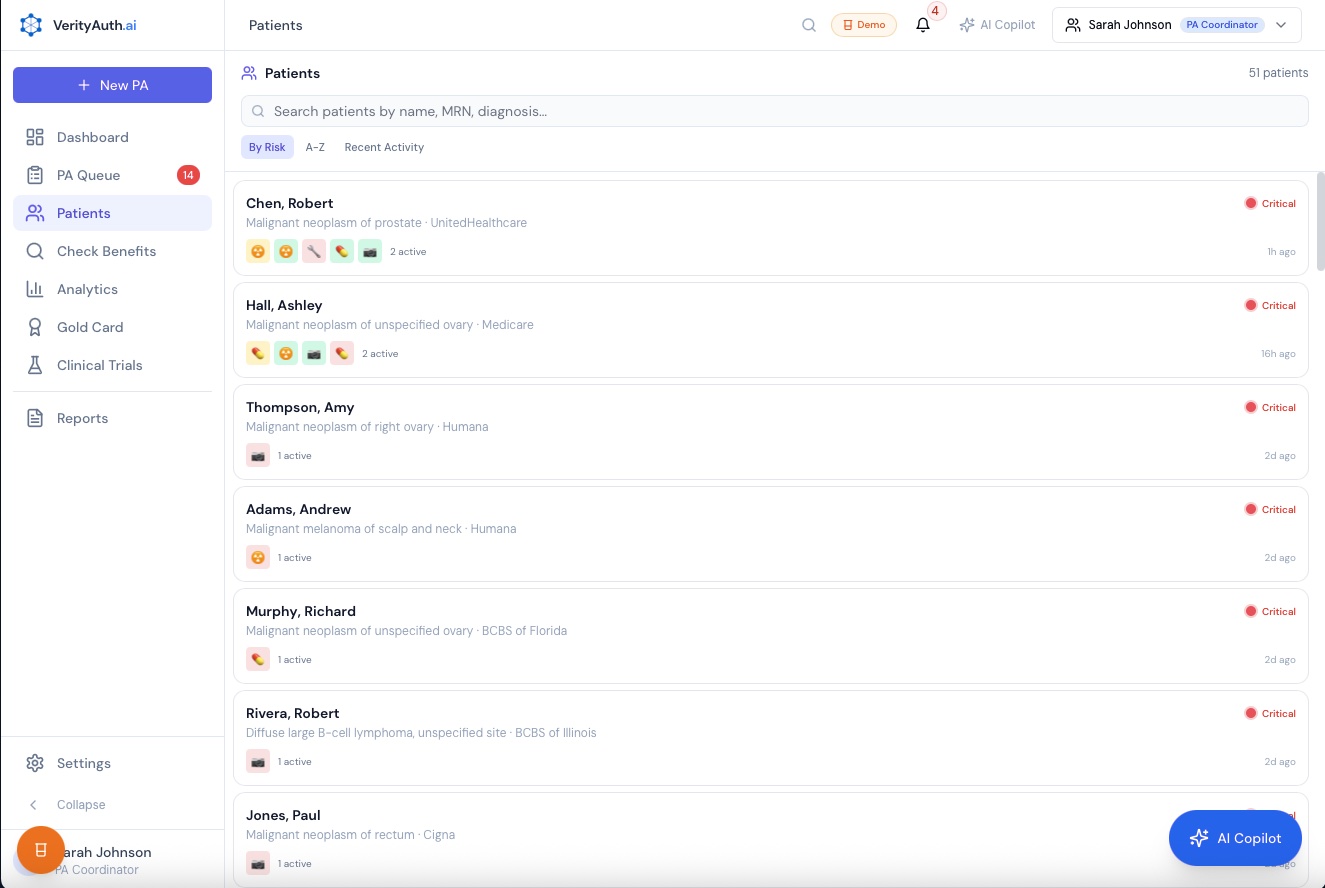
All PAs for one patient grouped together. Risk indicators, active cases, and diagnosis at a glance.
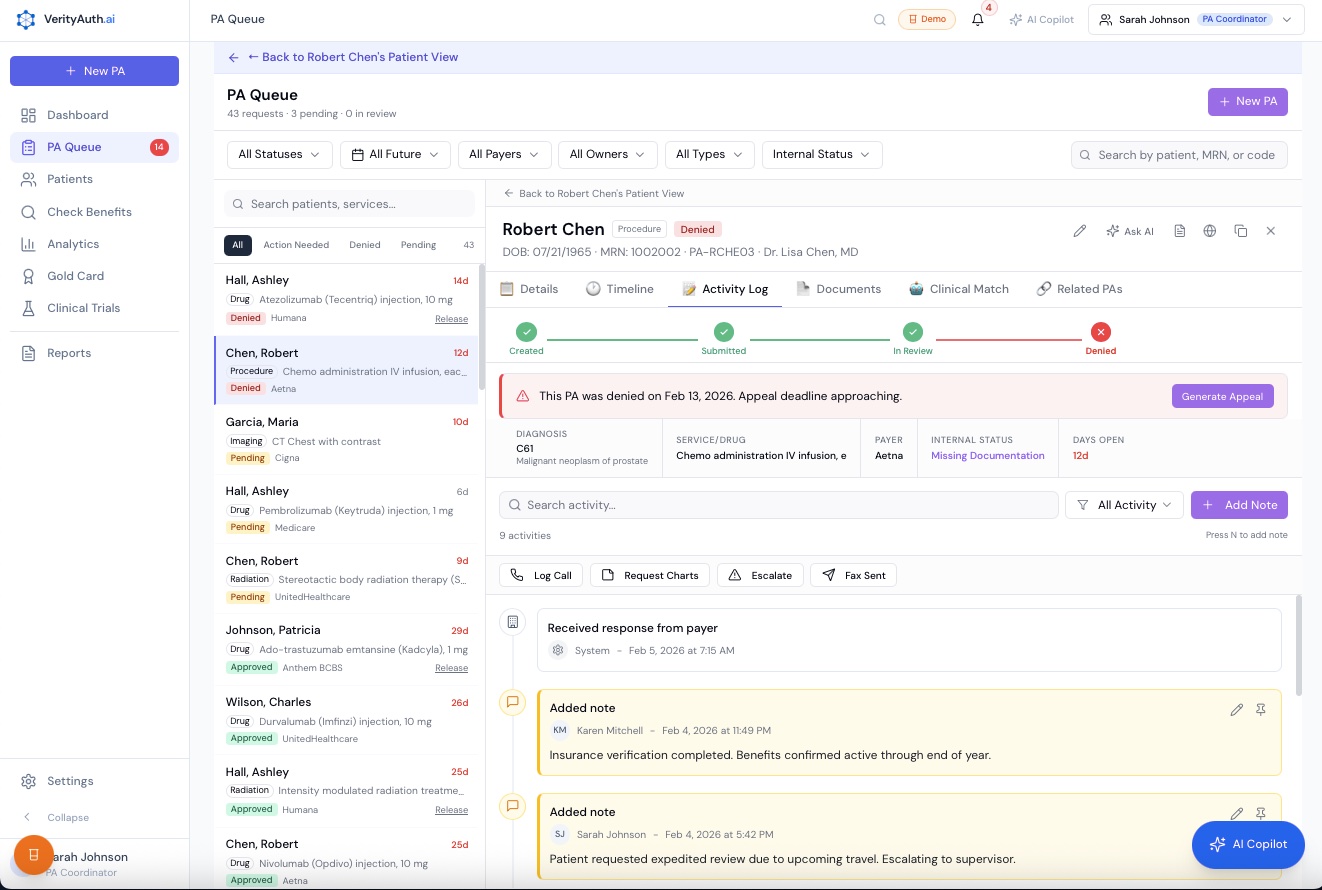
Full timeline for every PA. Who called, when, what happened. No more “did we hear back?”
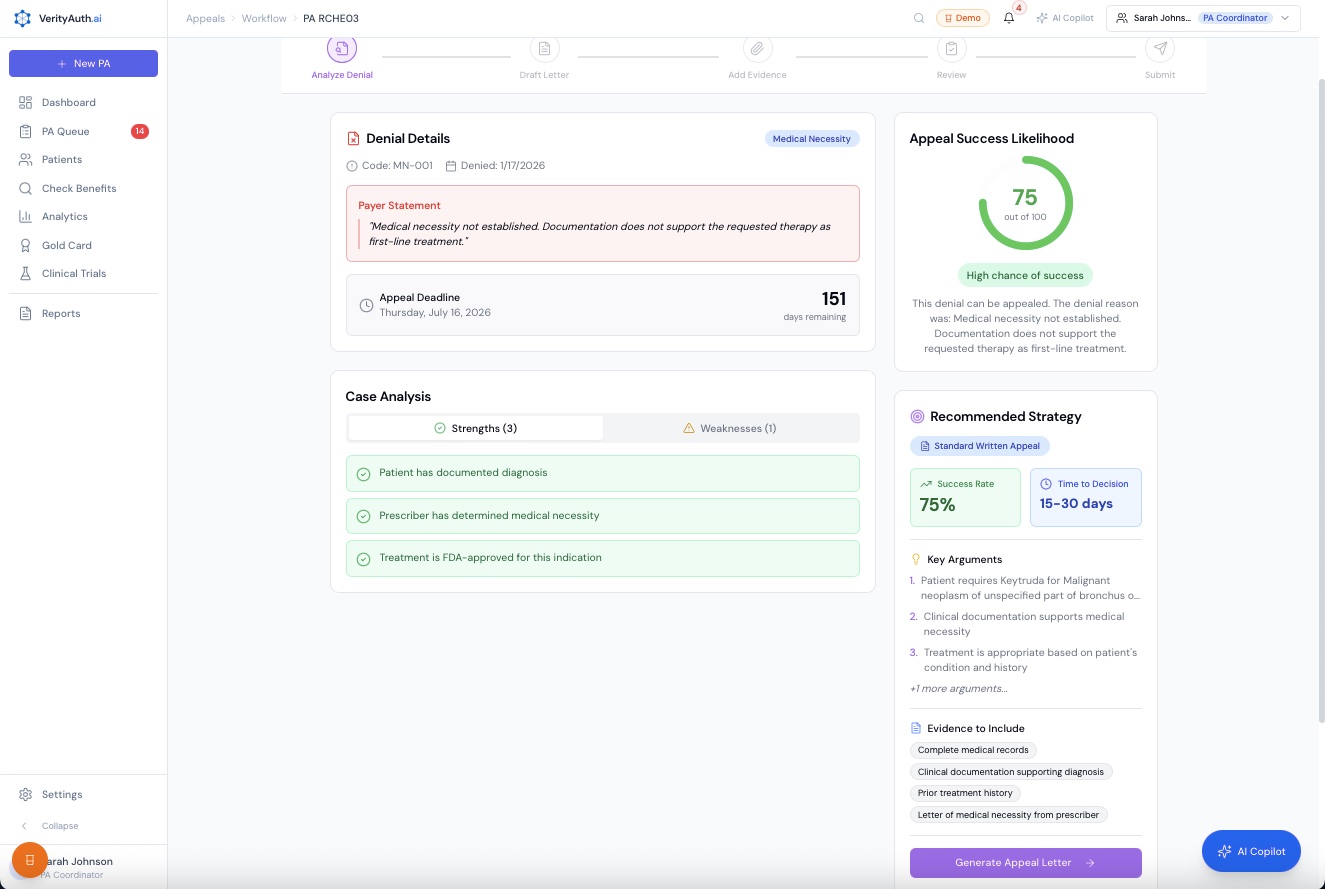
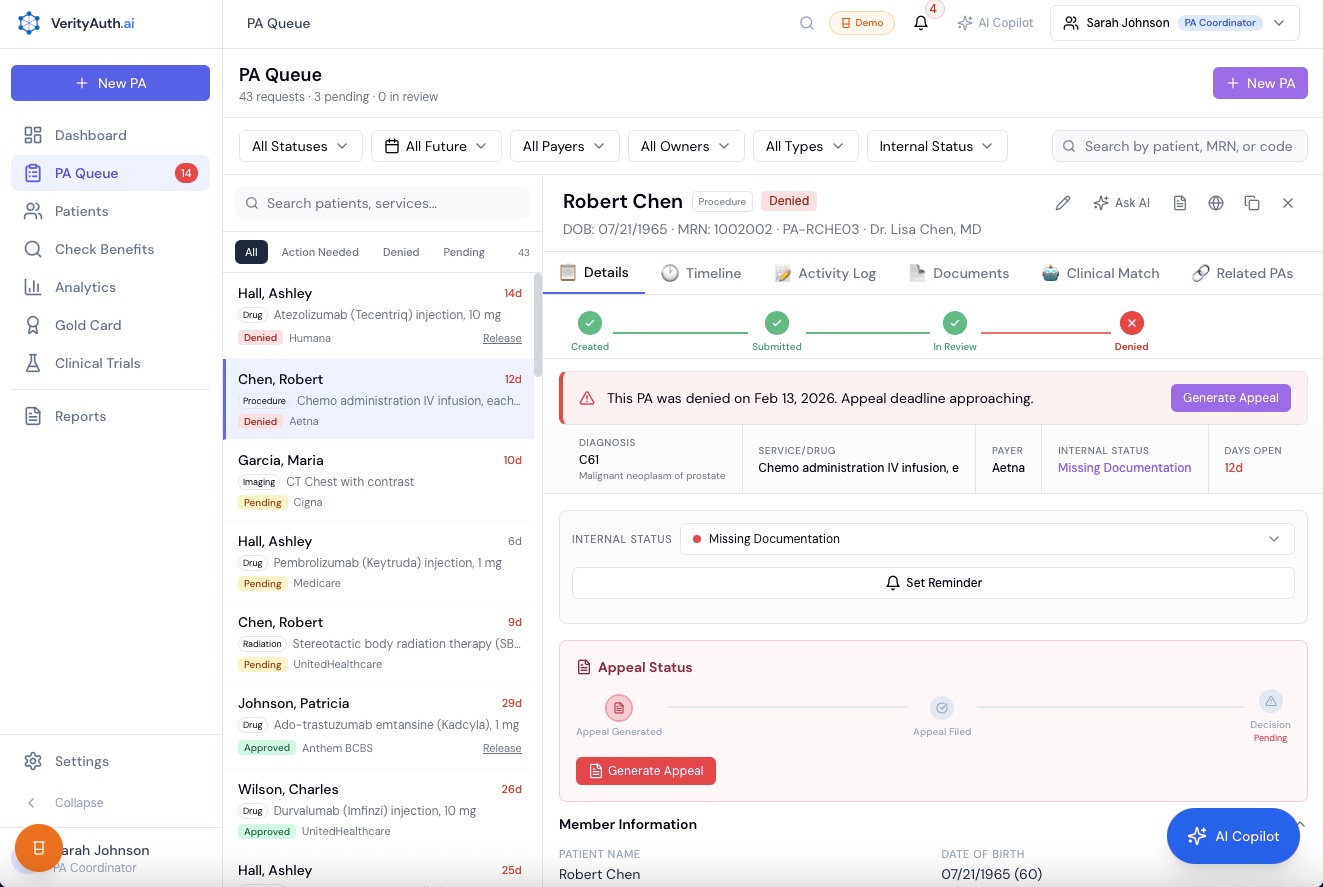
AI analyzes the denial, scores success likelihood, builds the case, and writes the letter. You click send.
Someone in your practice needs the big picture: are we keeping up? Who’s overloaded? Which payers are slow? Whether that’s an office manager, a practice administrator, or the lead physician — they need to answer one question above all: how much revenue are we losing to unappealed denials? VerityAuth answers it in real time and gives them the tools to turn lost revenue into recovered revenue.
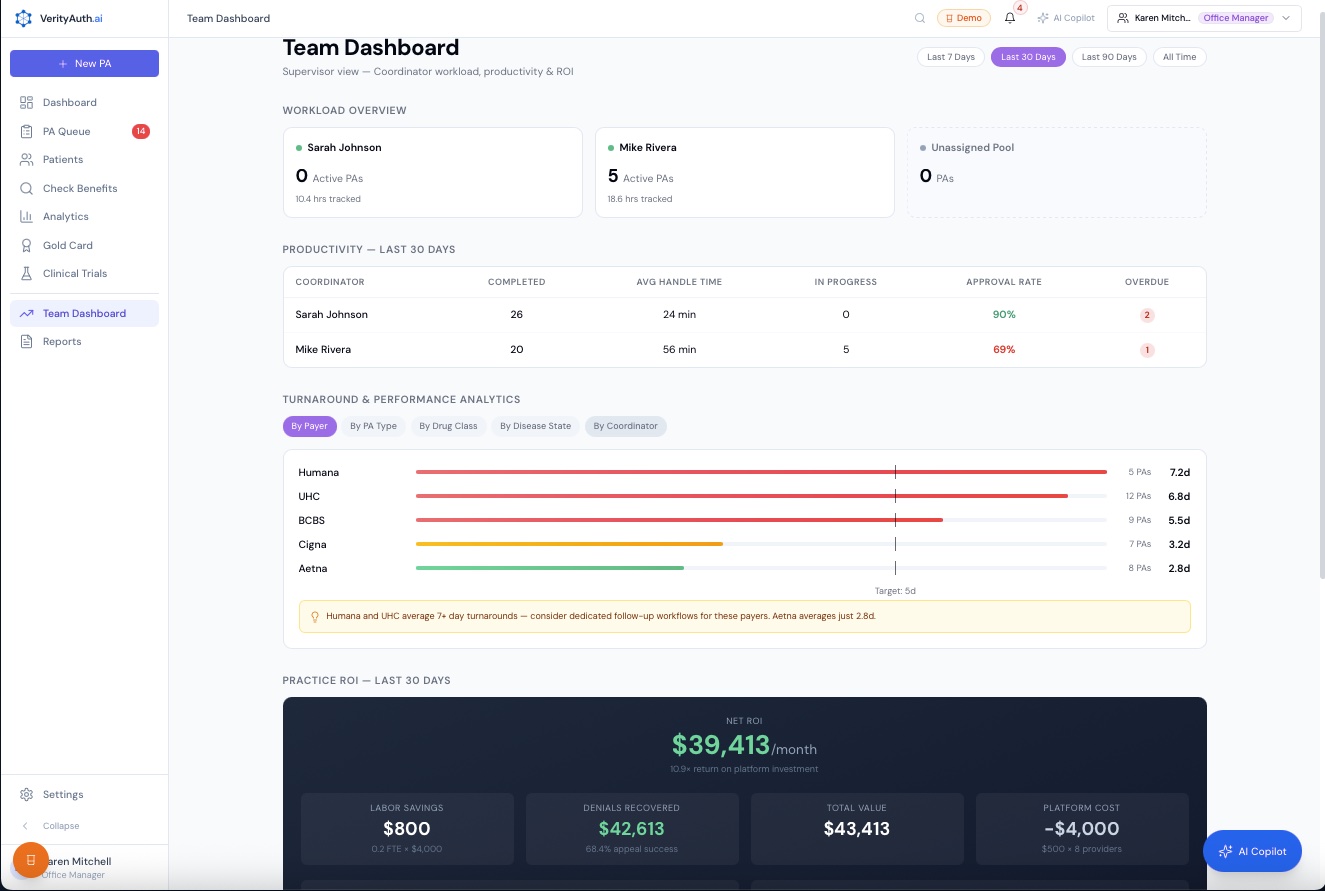
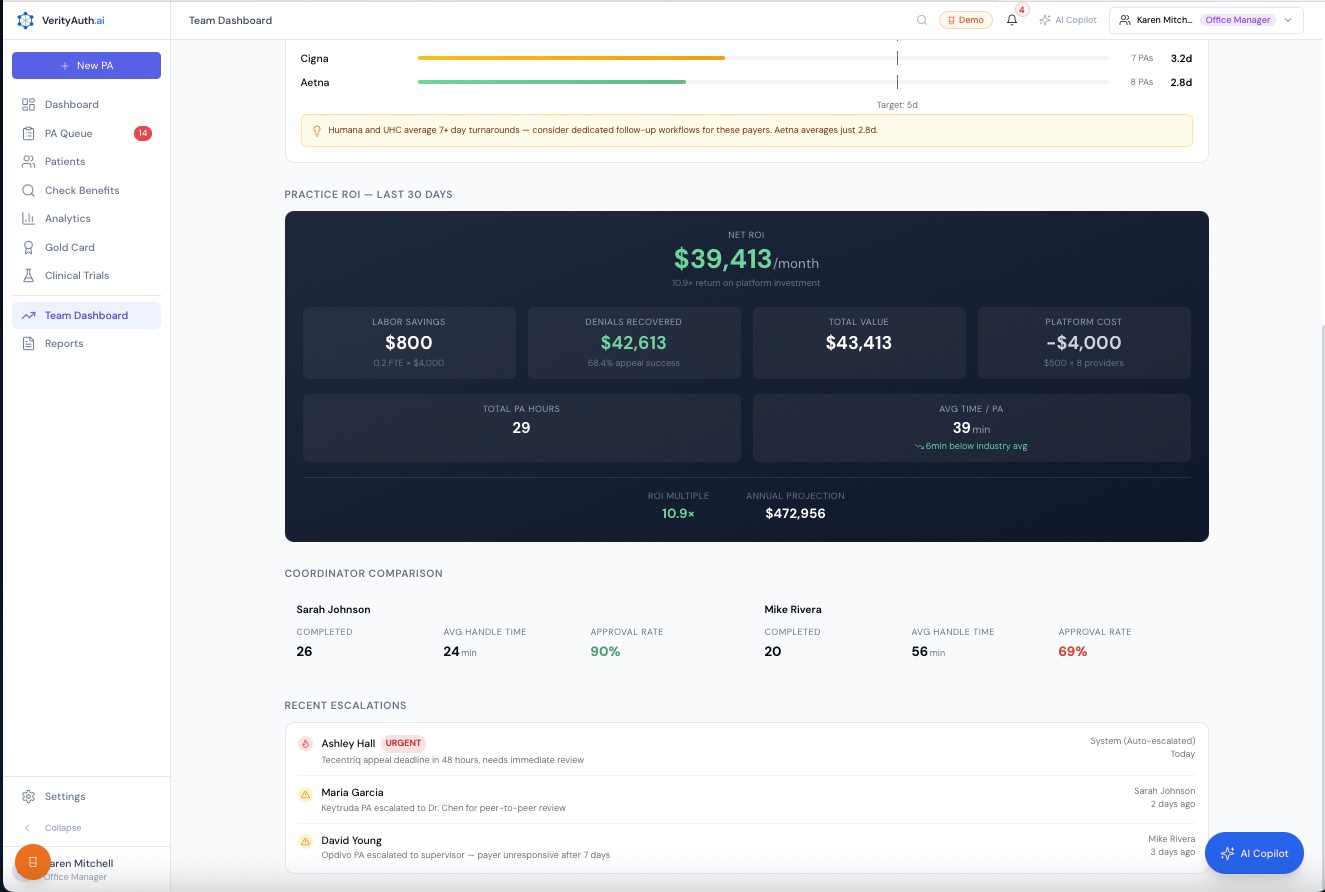
Denials recovered, labor savings, ROI multiple, annual projections. The math that justifies the investment.
PA volume by coordinator, average turnaround, workload distribution. Staff where the volume is.
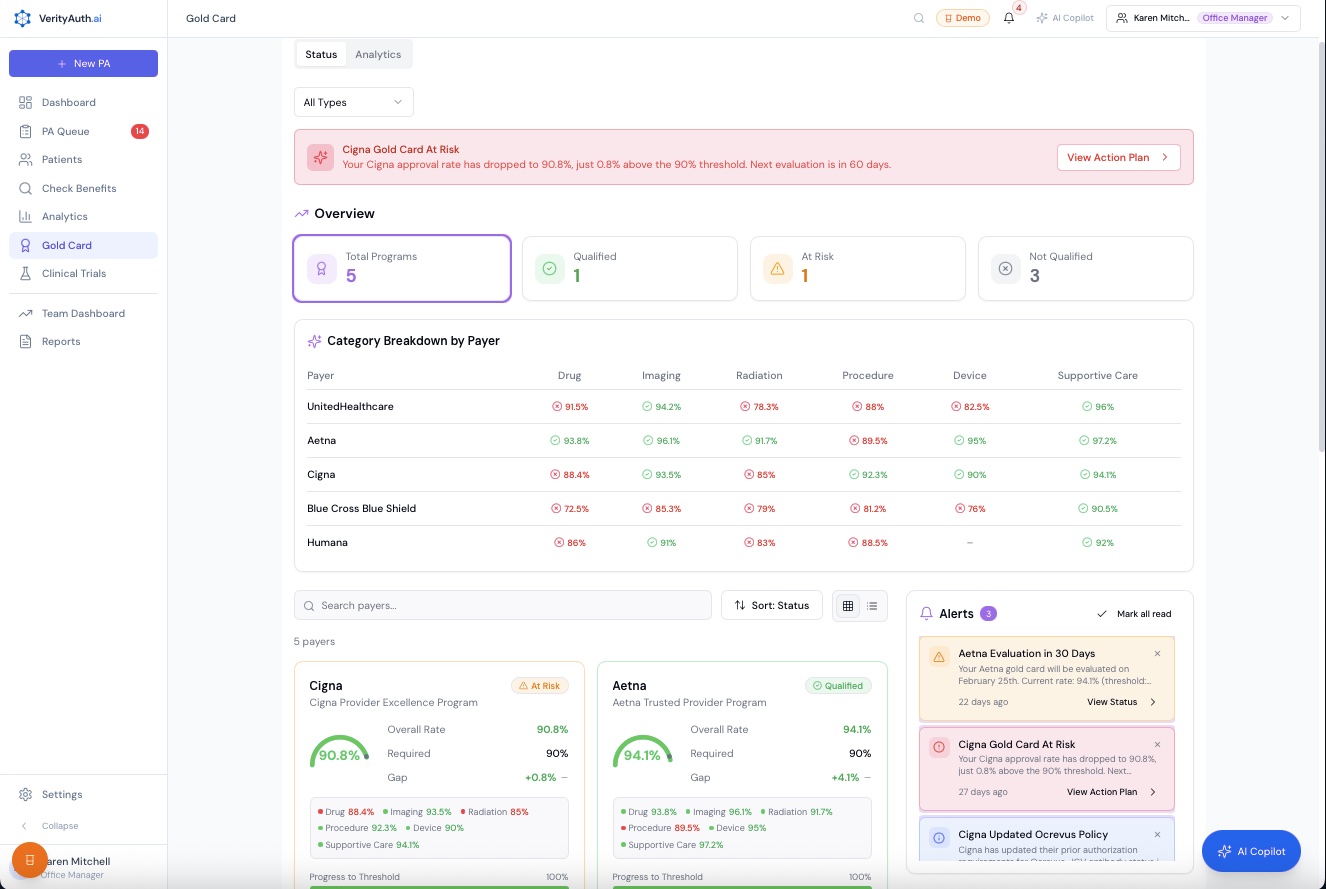
Gold card tracking, approval rates by payer and category, and alerts when thresholds are at risk.
Dr. Chen prescribes Keytruda because it’s the right drug for her patient. She shouldn’t have to wonder whether a payer will override her clinical judgment — and she definitely shouldn’t have to accept it when they do.
93% of oncologists report patients being forced onto second-choice therapy because of PA. Cancer Therapy Advisor Research shows that even 1–3 week delays in starting guideline-based treatment correlate with worse disease control and lower survival. Johns Hopkins Medicine
The system is overriding your clinical judgment, and your staff doesn’t have the time to fight back. VerityAuth fights back for you. Every denial appealed with NCCN-cited evidence. P2P talking points ready when the medical director calls. Your patients get what you prescribed — not what the payer’s algorithm substituted.
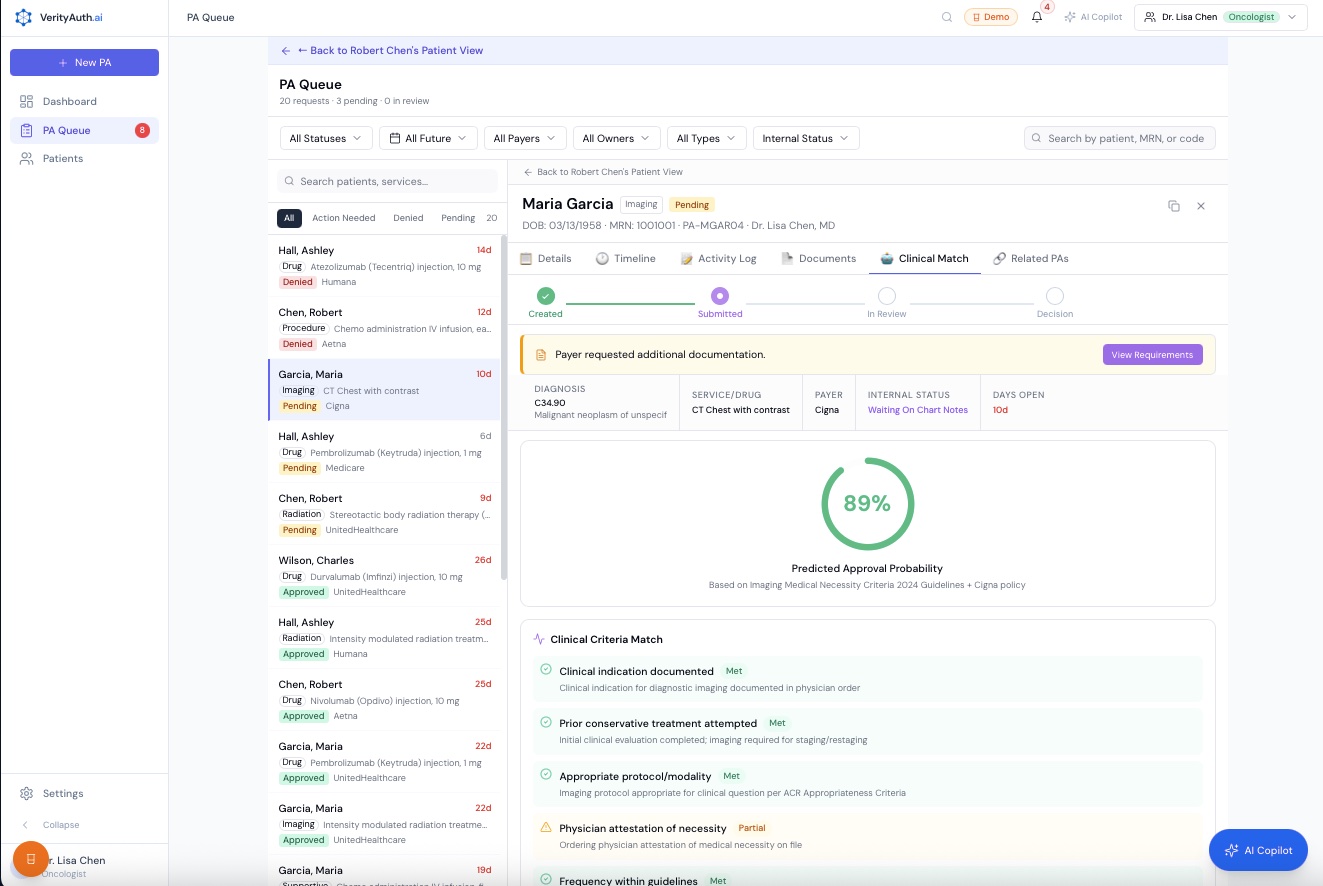
Clinical criteria matching with evidence citations specific to the patient’s regimen, stage, and biomarkers.
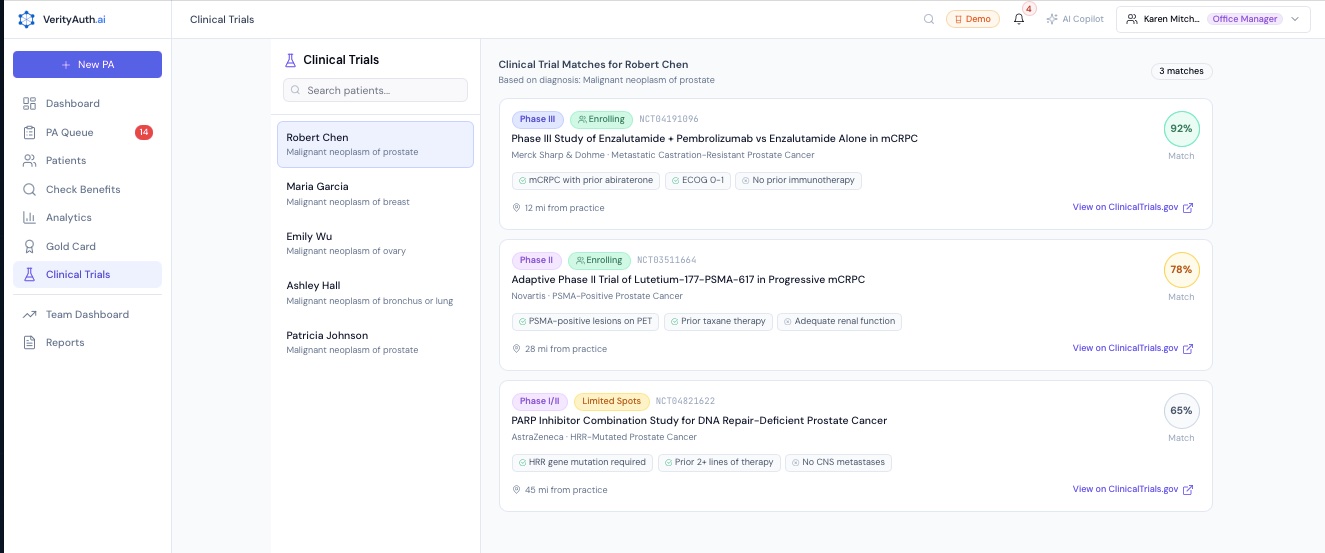
Eligibility scoring, distance filtering, and one-click sharing when the appeal path closes.
Case strength analysis, key arguments, and evidence recommendations — so your P2P call is airtight.
You don’t need hypothetical projections when you have the data. Your practice has denials every month that nobody appeals. VerityAuth appeals all of them. The numbers do the rest.
A single $35K appeal win covers the entire annual subscription. Everything after that is pure recovered revenue your practice was writing off before.
Every overturned denial is a patient who receives the treatment their oncologist actually prescribed — not the second-choice therapy the payer substituted. That’s the outcome that matters most.
Even with an 80% overturn rate, some denials stand. VerityAuth doesn’t let that be a dead end. The system automatically searches ClinicalTrials.gov for relevant trials and scores each by patient eligibility — turning a closed door into an alternative path.
No installation, no EHR integration, no IT department required.
Create your practice profile, add your providers, and connect your payer portal credentials. No software to install — it’s a web app.
Choose from Drug, Imaging, Radiation, Procedure, Device, or Supportive Care. Enter clinical details using category-specific forms. AI shows approval probability and required documentation.
Monitor every PA in one place. Follow-up reminders ensure nothing slips. If denied, AI generates the appeal letter and finds clinical trial alternatives. Every denial fought.
Simple per-provider pricing. All features included. No tiers, no add-ons, no implementation fees.
30 days free. No credit card. No obligation.
What oncology practices want to know before getting started.
VerityAuth supports eligibility verification across 3,400+ payers through our Stedi integration. PA submissions work with all commercial payers and Medicare. We add payer-specific criteria as customers need them.
No. VerityAuth is a standalone web application — no installation, no EHR integration, no IT involvement. Your staff logs in from any browser and starts submitting PAs immediately. EHR integration is on our v2 roadmap.
Most PA tools automate form-filling for drug PAs only. VerityAuth covers all 6 PA types with category-specific clinical forms, links related PAs so your staff enters patient data once, and includes a full coordination workspace — activity logs, follow-up reminders, team assignment, and supervisor dashboards with ROI tracking. The AI understands clinical content, matching regimens to NCCN guidelines, predicting approval likelihood, and generating evidence-based appeals.
Yes. All data is encrypted in transit (TLS 1.2+) and at rest (AES-256). We run on HIPAA-eligible AWS infrastructure and provide a signed BAA for every customer. We never use patient data to train AI models.
Simple per-provider monthly subscription. All features included — no per-PA fees, no setup costs, no hidden charges. We’ll walk through pricing during your demo so we can tailor it to your practice size. The pilot period is completely free.
Yes. The interface is intuitive — if your staff can use a payer portal, they can use VerityAuth. We also provide a guided onboarding session and an in-app AI copilot for questions.
CMS is requiring payers to support electronic prior authorization by 2027. Practices that adopt electronic PA tools now will be ahead of the curve — and tools like VerityAuth will become essential infrastructure.
Both — and that’s the point. Faster PA processing means faster treatment starts. Every denial gets appealed with NCCN-backed evidence, so patients get the drug you prescribed instead of a second-choice alternative. Clinical trial matching turns final denials into new options. And the platform tracks clinical impact from day one — turnaround time, forced substitutions avoided, appeals won.
The stats we cite — denial rates, appeal success rates, and clinical impact data — come from KFF’s Medicare Advantage analysis, the AMA’s Prior Authorization Physician Survey, ASCO policy statements, ASTRO surveys, and published research from Johns Hopkins Medicine. These are the most trusted sources in healthcare policy.
Every week without VerityAuth is another round of denials that go uncontested, revenue that walks out the door, and patients who don’t get the treatment you prescribed. Try the live demo or tell us about your practice.
Try Live Demo